Execution form
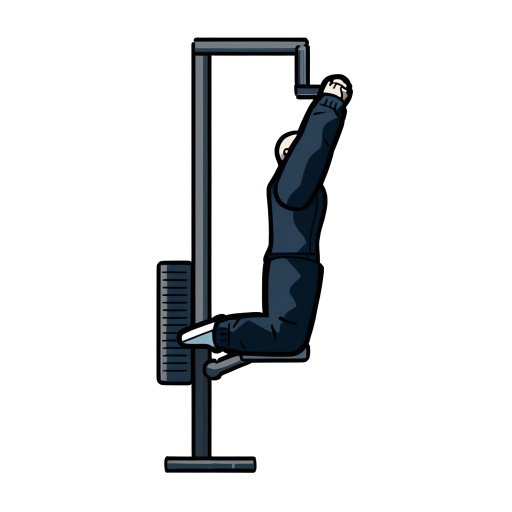
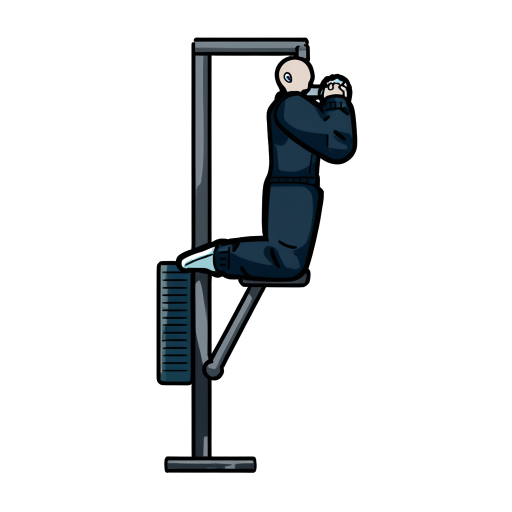
- EquipmentMachine
- PatternPull
- Reps5 to 15 reps
- Joint loadShoulder
How to do the Assisted Pull-Up
Set up. Choose an assistance weight, kneel or stand on the platform and grip the handles above you with straight arms.
- Pull your shoulder blades down.
- Pull yourself up until your chin is over the handles.
- Lower under control to straight arms.
Form cues
- More assistance makes it easier.
- Keep the chest up.
- Use the full range every rep.
Common mistakes
- Bouncing off the platform at the bottom.
- Using so much assistance that the set stops being hard.
Muscles worked
Main target: Lats. The latissimus dorsi is the widest muscle of the back, running from the lower spine and pelvis up under the arm to the upper arm bone. It pulls the arm down and back: pull-ups, pulldowns and the start of a deadlift.
On the way: Biceps and Upper back.
Its other side: Chest, Front delts and Triceps, in the horizontal push and pull pattern.
Its other side: Side delts and Triceps, in the overhead press and pull pattern.
What to pair it with
Movements that round out a workout with the Assisted Pull-Up, from the same catalog the StatBlockFit app logs.
- Cable Upright Row Superset partner: it trains the other side of the overhead press and pull pattern, so the two can alternate.
- Face Pull Same pull session: it trains the rear delts.
- Power Clean Same pull session: it trains the traps.
A complete workout around it
4 movements, the Assisted Pull-Up first, at the catalog's rep ranges. Load it into the workout builder to change the sets, reps and weights, then bookmark it or download it.
- Assisted Pull-Up 3 × 5 to 15 reps
- Cable Upright Row 3 × 10 to 15 reps
- Face Pull 3 × 12 to 20 reps
- Power Clean 3 × 1 to 5 reps
Alternatives and swaps
The same main muscle with other equipment: a swap never changes the muscle a workout trains.
Home or dumbbell swap
Pull-Up
Bodyweight
Gym or cable swap
Lat Pulldown
Cable
Less load on the shoulder
Lat Pulldown
The Assisted Pull-Up loads the shoulder by the catalog's joint rule, the one the app's workaround mode uses; this one does not.
A swap describes the movement, not your body: if a joint hurts, ask a professional before you train it.
Working weight and 1RM calculator
Enter a set you did: the weight, the reps and how many more reps you had left in you. The estimate is the formula the StatBlockFit app uses for its records, weight × (1 + (reps + reps in reserve) ÷ 30); above 12 reps it is rough.
Training zones
| Zone | Share of 1RM | Usual reps |
|---|---|---|
| Strength | 85 to 90 % | 3 to 6 |
| Muscle growth | 70 to 80 % | 6 to 12 |
| Endurance | 60 to 65 % | 15 to 20 |
A warm-up before the working sets: 50 % for 5, 70 % for 3 and 85 % for 1, each rounded down to a plate.
Common starting points, not a prescription: the right weight is the one you can lift with good form for the reps you planned.
Variations and preparation
A variation of: Pull-Up.
Other variations of the Pull-Up: Chin-Up, Lat Pulldown, Band-Assisted Pull-Up, Negative Pull-Up and Scapular Pull-Up.
Do before it: Scapular Pull-Up (shoulder blades), Dead Hang (same movement, lighter), Band Pull-Apart (shoulder blades) and Inverted Row (same movement, lighter).
Track it in StatBlockFit
In the StatBlockFit app the Assisted Pull-Up is logged set by set: the app suggests your next weight after each session, times your rests, keeps your records and shows the 72-hour recovery of every muscle on its training map. The training guide explains how.
Questions
How do you do the Assisted Pull-Up?
Set up: Choose an assistance weight, kneel or stand on the platform and grip the handles above you with straight arms. Steps: 1. Pull your shoulder blades down. 2. Pull yourself up until your chin is over the handles. 3. Lower under control to straight arms. Form cues: More assistance makes it easier. Keep the chest up. Use the full range every rep. Common mistakes: Bouncing off the platform at the bottom. Using so much assistance that the set stops being hard.
What muscles does the Assisted Pull-Up work?
It trains the lats as its main target and works the biceps and upper back on the way.
What can I do instead of the Assisted Pull-Up?
At home: Pull-Up. In a gym: Lat Pulldown. With less load on the shoulder: Lat Pulldown. Each trains the same main muscle.
What should I pair the Assisted Pull-Up with?
Good partners in the same workout are Cable Upright Row, Face Pull and Power Clean.
How heavy should the Assisted Pull-Up be?
Pick a weight you can lift for the planned reps with one or two left in reserve. As a common starting point, sets of 3 to 6 reps use about 85 to 90 percent of your one-rep max and sets of 6 to 12 reps about 70 to 80 percent; the calculator on this page does the arithmetic.