- EquipmentKettlebell
- PatternHinge
- Reps10 to 30 reps
- Joint loadLower back
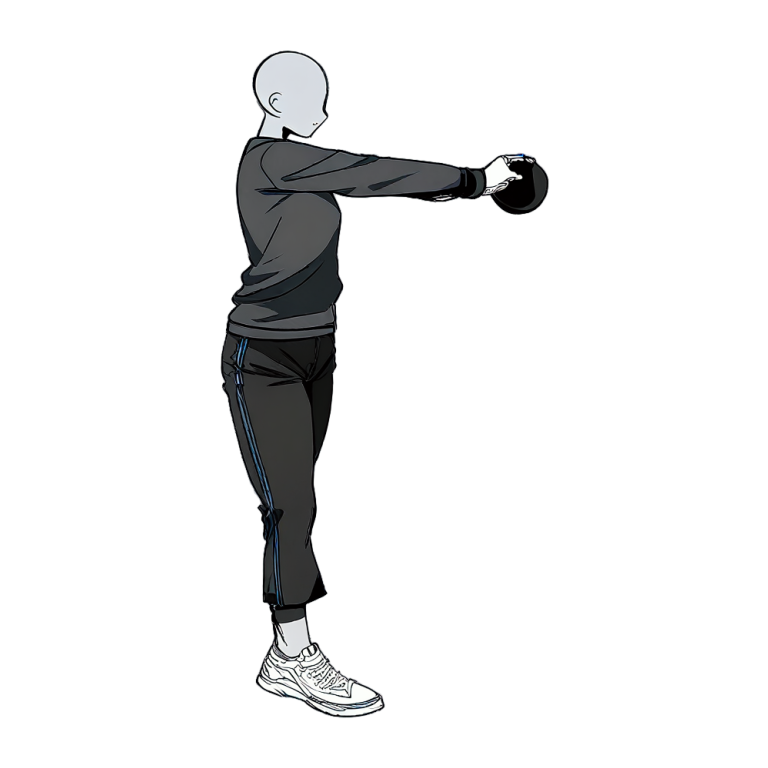
How to do the Kettlebell Swing
Set up. Stand with your feet a little wider than your hips and a kettlebell on the floor a short way in front. Hinge down with a flat back and grip the handle with both hands.
- Hike the kettlebell back between your legs.
- Snap your hips forward to stand tall, letting the bell float up to about chest height.
- Let it swing back down and hinge to meet it.
- At the end, hinge and park the bell on the floor in front of you.
Form cues
- It is a hip hinge, not a squat.
- The arms guide the bell, the hips move it.
- Stand tall with glutes tight at the top.
Common mistakes
- Lifting the bell with the arms.
- Rounding the back as the bell swings down.
Muscles worked
Main target: Glutes. The glutes are the three muscles of the buttock. They extend the hip, standing up out of a squat or finishing a hinge, and keep the pelvis level on one leg.
On the way: Hamstrings, Lower back and Abs.
Its other side: Quads, in the knees and hips pattern.
What to pair it with
Movements that round out a workout with the Kettlebell Swing, from the same catalog the StatBlockFit app logs.
- Bulgarian Split Squat Superset partner: it trains the other side of the knees and hips pattern, so the two can alternate.
- Seated Calf Raise Same legs session: it trains the calves.
- Cossack Squat Same legs session: it trains the adductors.
- Hip Abduction Often left out: it trains the abductors, a job the moves above leave undone.
A complete workout around it
5 movements, the Kettlebell Swing first, at the catalog's rep ranges. Load it into the workout builder to change the sets, reps and weights, then bookmark it or download it.
- Kettlebell Swing 3 × 10 to 30 reps
- Bulgarian Split Squat 3 × 6 to 15 reps
- Seated Calf Raise 3 × 10 to 25 reps
- Cossack Squat 3 × 5 to 15 reps
- Hip Abduction 3 × 12 to 25 reps
Alternatives and swaps
The same main muscle with other equipment: a swap never changes the muscle a workout trains.
Home or dumbbell swap
Glute Bridge
Bodyweight
Gym or cable swap
Cable Pull-Through
Cable
Less load on the lower back
Hip Thrust
The Kettlebell Swing loads the lower back by the catalog's joint rule, the one the app's workaround mode uses; this one does not.
A swap describes the movement, not your body: if a joint hurts, ask a professional before you train it.
Working weight and 1RM calculator
Enter a set you did: the weight, the reps and how many more reps you had left in you. The estimate is the formula the StatBlockFit app uses for its records, weight × (1 + (reps + reps in reserve) ÷ 30); above 12 reps it is rough.
Training zones
| Zone | Share of 1RM | Usual reps |
|---|---|---|
| Strength | 85 to 90 % | 3 to 6 |
| Muscle growth | 70 to 80 % | 6 to 12 |
| Endurance | 60 to 65 % | 15 to 20 |
A warm-up before the working sets: 50 % for 5, 70 % for 3 and 85 % for 1, each rounded down to a plate.
Common starting points, not a prescription: the right weight is the one you can lift with good form for the reps you planned.
Variations and preparation
Do before it: Glute Bridge (glutes switched on), Hip Flexor Stretch (hip range) and Broomstick Hip Hinge (same movement, lighter).
Track it in StatBlockFit
In the StatBlockFit app the Kettlebell Swing is logged set by set: the app suggests your next weight after each session, times your rests, keeps your records and shows the 72-hour recovery of every muscle on its training map. The training guide explains how.
Questions
How do you do the Kettlebell Swing?
Set up: Stand with your feet a little wider than your hips and a kettlebell on the floor a short way in front. Hinge down with a flat back and grip the handle with both hands. Steps: 1. Hike the kettlebell back between your legs. 2. Snap your hips forward to stand tall, letting the bell float up to about chest height. 3. Let it swing back down and hinge to meet it. 4. At the end, hinge and park the bell on the floor in front of you. Form cues: It is a hip hinge, not a squat. The arms guide the bell, the hips move it. Stand tall with glutes tight at the top. Common mistakes: Lifting the bell with the arms. Rounding the back as the bell swings down.
What muscles does the Kettlebell Swing work?
It trains the glutes as its main target and works the hamstrings, lower back and abs on the way.
What can I do instead of the Kettlebell Swing?
At home: Glute Bridge. In a gym: Cable Pull-Through. With less load on the lower back: Hip Thrust. Each trains the same main muscle.
What should I pair the Kettlebell Swing with?
Good partners in the same workout are Bulgarian Split Squat, Seated Calf Raise, Cossack Squat and Hip Abduction.
How heavy should the Kettlebell Swing be?
Pick a weight you can lift for the planned reps with one or two left in reserve. As a common starting point, sets of 3 to 6 reps use about 85 to 90 percent of your one-rep max and sets of 6 to 12 reps about 70 to 80 percent; the calculator on this page does the arithmetic.